Fun Math Games for Kids That Make Practice Feel Like Play (Fractions, Times Tables & More)
15 fun math games for kids, by skill and grade: counting, addition, times tables, fractions, place value and telling time. Most need only dice, cards or paper.
By The Castellan Team · · 5 min read
The best math games for kids don't feel like math. They feel like racing, collecting, beating a sibling or rescuing a squishy clock. Below are 15 fun math games organized by skill and grade: counting, addition, times tables, fractions, place value and telling time. Most need nothing more than dice, cards or paper, and they're backed by research showing that playing number games builds real math understanding.
Why math games work (it's not just "making it fun")
In a frequently cited study, researchers Robert Siegler and Geetha Ramani had preschoolers from low-income backgrounds play a simple numbered board game, a lot like Chutes and Ladders without the chutes, for four short sessions. Compared with children who played the same game with colors instead of numbers, they improved on several number skills, including estimating where numbers fall on a number line (Siegler & Ramani, 2008). Researchers at Dartmouth's Tiltfactor lab have written about how that kind of linear board game helps children "see" the number line (Tiltfactor).
Games also do something worksheets can't: kids choose to repeat them. The fifth round of a game is voluntary practice, and that kind of practice sticks.
Math games for preschool and kindergarten (ages 3–6)
1. Number line race
Draw a path of squares numbered 1 to 20. Roll a die, count the dots, move that many squares, and say each number out loud as you land. It's the same type of game used in the research above. Saying the numbers is the magic ingredient.
2. Snack counting
Count crackers onto two plates. "Who has more? How many more?" Then eat to subtract. Few math lessons are this popular.
3. Dice dot spotting
Roll a die and shout the number without counting the dots. Recognizing small quantities at a glance (called subitizing) is a big early milestone.
4. Card pack flashcard games
Turn flashcards into a game: lay out number cards and call "Find the number that comes after 7!" or play matching pairs with shapes. Our Card Pack Bundle has 416 teacher-designed cards across six sets, covering counting to 20, letters, adding and subtracting to 20, shapes and colors, and telling time. That's enough variety for a different game every night.
Addition and subtraction games (ages 5–8)
By the end of Grade 2, the US Common Core expects children to add and subtract within 20 fluently in their heads (Common Core 2.OA.B.2). These games make that fluency automatic.
5. Shut the Box
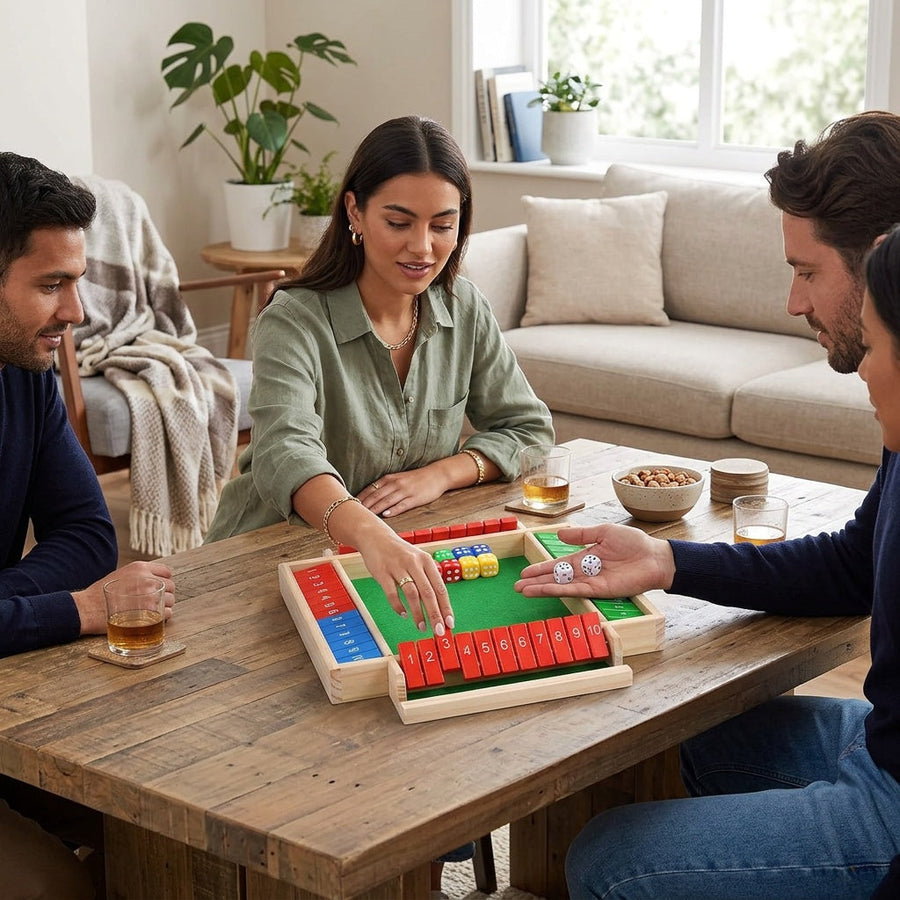
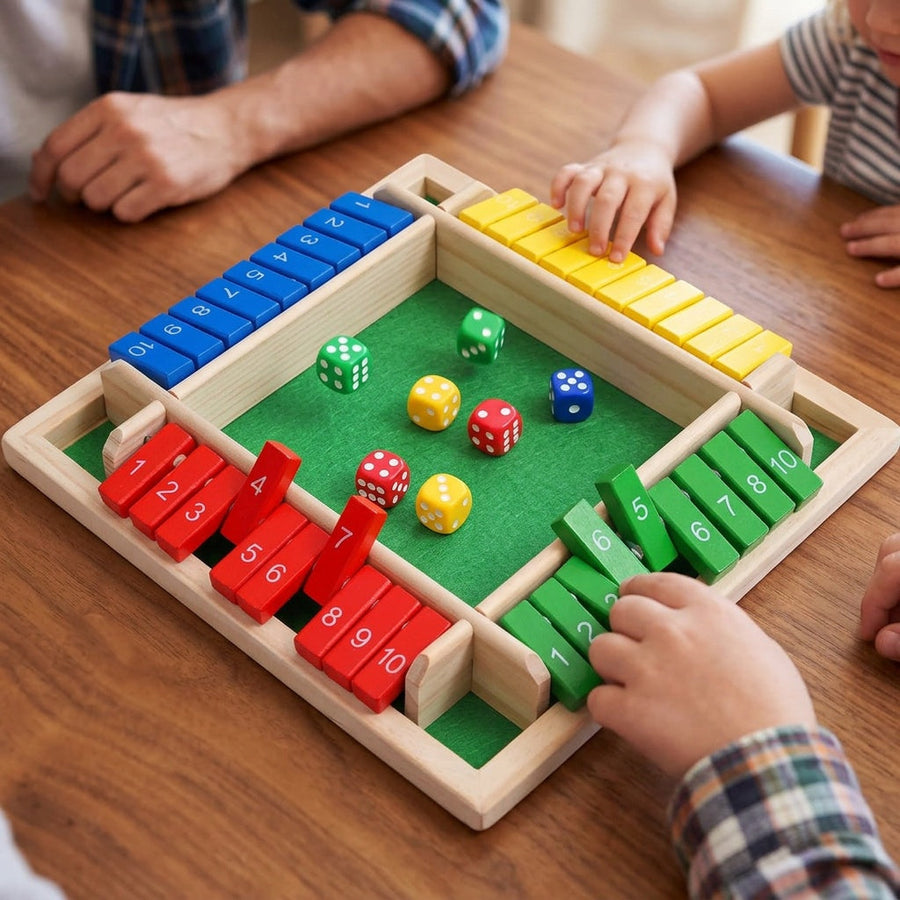
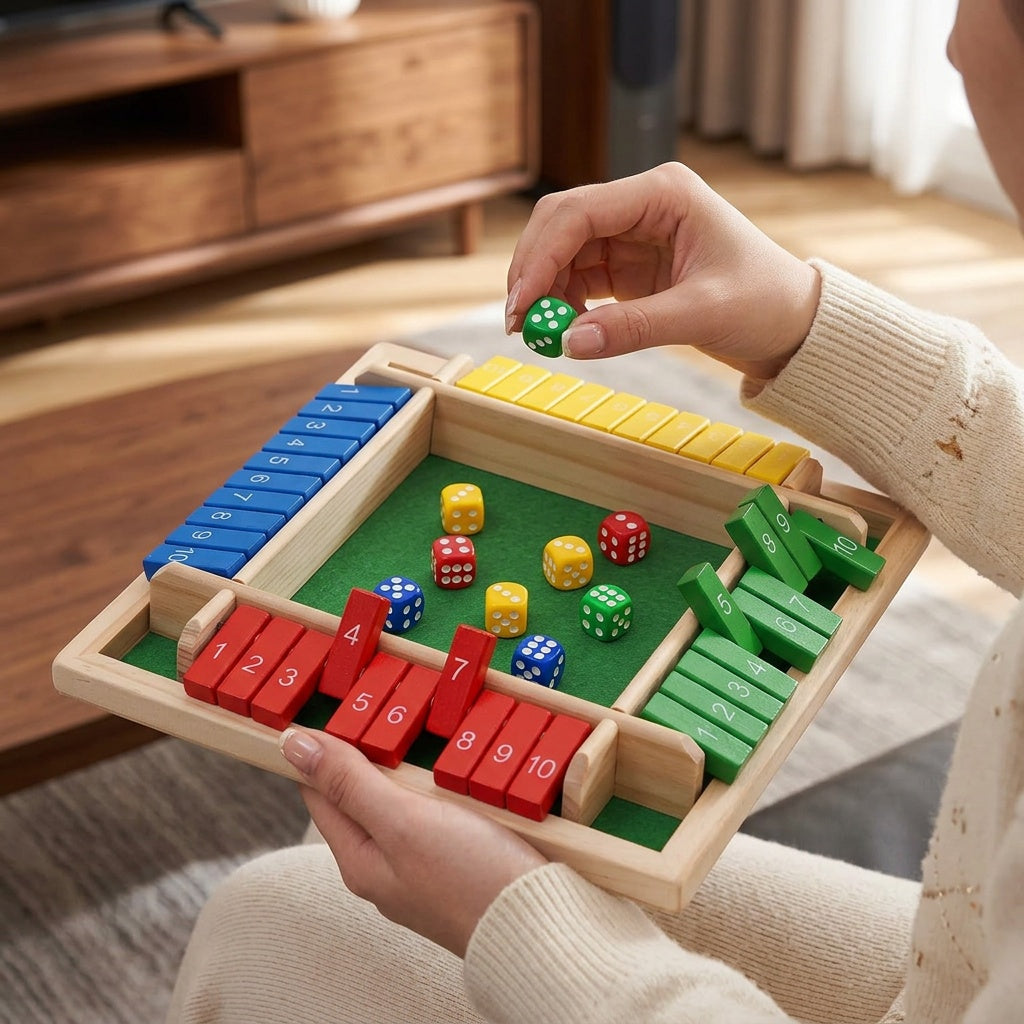
Roll two dice and flip down numbered tiles that add up to the total. Rolled 8? Flip the 8, or 5 + 3, or 1 + 2 + 5. Every turn is a number-bond puzzle, and rounds take two minutes. Our wooden Shut the Box seats four players at once. Read the full Shut the Box rules, strategy and math.
6. Make 10
Deal out playing cards (remove face cards; aces are 1). Players flip cards and grab any pair that makes 10. "Tens friends" are the foundation for mental addition and subtraction.
7. Subtraction war
Each player flips two cards and subtracts the smaller from the larger. The biggest difference wins all four cards. It's simple, fast and very competitive.
8. Math Ahoy
One of the four games in our Ultimate Math Bundle, Math Ahoy is all about adding and subtracting. The bundle is built to make facts within 10 and 20 automatic.
Times tables games (ages 7–10)
By the end of Grade 3, Common Core expects children to know all products of two one-digit numbers from memory (Common Core 3.OA.C.7). That's a lot of facts. Games turn the memorizing into competing.
9. Multiplication war
Each player flips two cards and multiplies them. The highest product wins the round. Want to practice one table? Fix one card (all 7s) and flip the other.
10. Times table bingo
Fill bingo grids with products (12, 24, 36…). Call out facts like "4 × 6" and players cover the answer.
11. Number Ninja
Also in the Ultimate Math Bundle, Number Ninja practices multiplication and division facts to build mental math speed.
Fraction games (ages 6–9)
Fractions start earlier than many parents expect. Common Core has children splitting circles and rectangles into halves and fourths in Grade 1 (1.G.A.3), adding thirds in Grade 2, and working with fractions as numbers in Grade 3 (3.NF).
12. Pizza fractions
Cut a paper plate "pizza" into halves, then quarters, then eighths. "Would you rather have 1/2 or 3/8?" Eat the real pizza after.
13. Fraction Food Frenzy
Our Fraction Food Frenzy board game sends 2–6 players around an island collecting food cards and matching magnetic fraction tiles, from wholes to halves, fourths and beyond. Fractions become something kids can hold and compare, not just a picture on a worksheet. Designed for Grades 1–3, 15–20 minutes.
Place value and telling time games (ages 6–10)
14. Biggest number wins
Roll a die three times. After each roll, place the digit in your hundreds, tens or ones column, with no moving once placed. The biggest three-digit number wins. It's a brilliant lesson in why place value matters. The Rocket Race game in our Ultimate Math Bundle is all about place value, and the bundle covers ones, tens and hundreds in standard, expanded and word form.
15. What time is it, Mr. Wolf? (clock edition)
Instead of calling a time aloud, Mr. Wolf shows it on a toy clock, and players must read it before stepping. Children are expected to tell time to the nearest five minutes in Grade 2 and to the nearest minute in Grade 3 (3.MD.A.1). Squishy Time Rescue in the Ultimate Math Bundle is our telling-time game, and the bundle also covers elapsed time.
Math games by grade at a glance
| Grade | Big skill | Try |
|---|---|---|
| Pre-K–K | Counting to 20, number recognition | Number line race, Card Pack Bundle |
| Grade 1 | Adding within 20, halves and fourths | Make 10, Shut the Box |
| Grade 2 | Fluency within 20, place value, time to 5 min | Biggest number wins, Math Ahoy |
| Grade 3 | Times tables, fractions, time to the minute | Multiplication war, Fraction Food Frenzy |
| Grade 4 | Multi-digit thinking, problem solving | Ultimate Math Bundle |
How to make math games stick
- Say it out loud. "Five plus three is eight" while flipping tiles is worth more than silent moves.
- Play little and often. Three 10-minute games a week beat one long session.
- Let luck level the field. Dice and cards mean younger siblings can beat older ones, which keeps everyone playing.
- Talk strategy, not answers. "Why did you choose the 8?" builds reasoning.
- Never use games as punishment. Keep math and fun firmly in the same box.
Want ready-to-play math? Our Math Masters collection covers counting, fractions, times tables, place value and telling time, and the bundles save the most. Pair it with our guide to sight word games for a full learning-through-play rotation, or see the 15 best family board games.
Math games FAQ
Do math games actually improve math skills?
Yes. In research by Siegler and Ramani, young children who played a numbered board game for just four short sessions improved several number skills (2008). Games also encourage the voluntary repetition that builds fluency.
What is a good math game for a 7-year-old?
Shut the Box, Make 10 and Multiplication War are great at this age. They practice mental addition and early multiplication in short, competitive rounds.
How can I make times tables fun?
Turn facts into a contest: Multiplication War with playing cards, times table bingo, or a themed game like Number Ninja. Focus on one table at a time and celebrate streaks.
When do kids learn fractions?
Under Common Core, children start splitting shapes into halves and fourths in Grade 1, add thirds in Grade 2, and treat fractions as numbers on a number line in Grade 3.
Ready for game night?
Wooden classics and teacher-designed learning games that get the whole table playing in under 20 minutes.